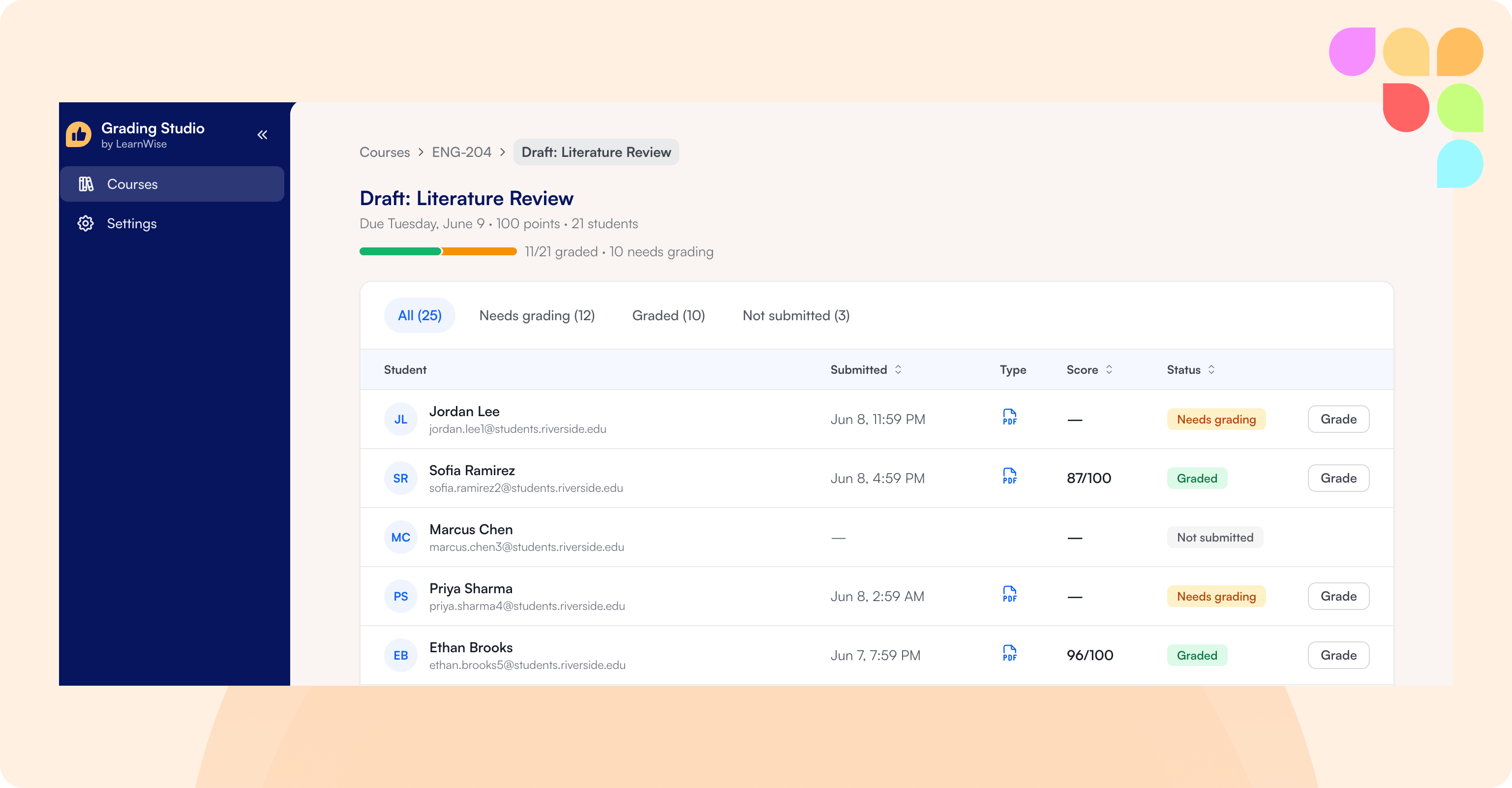
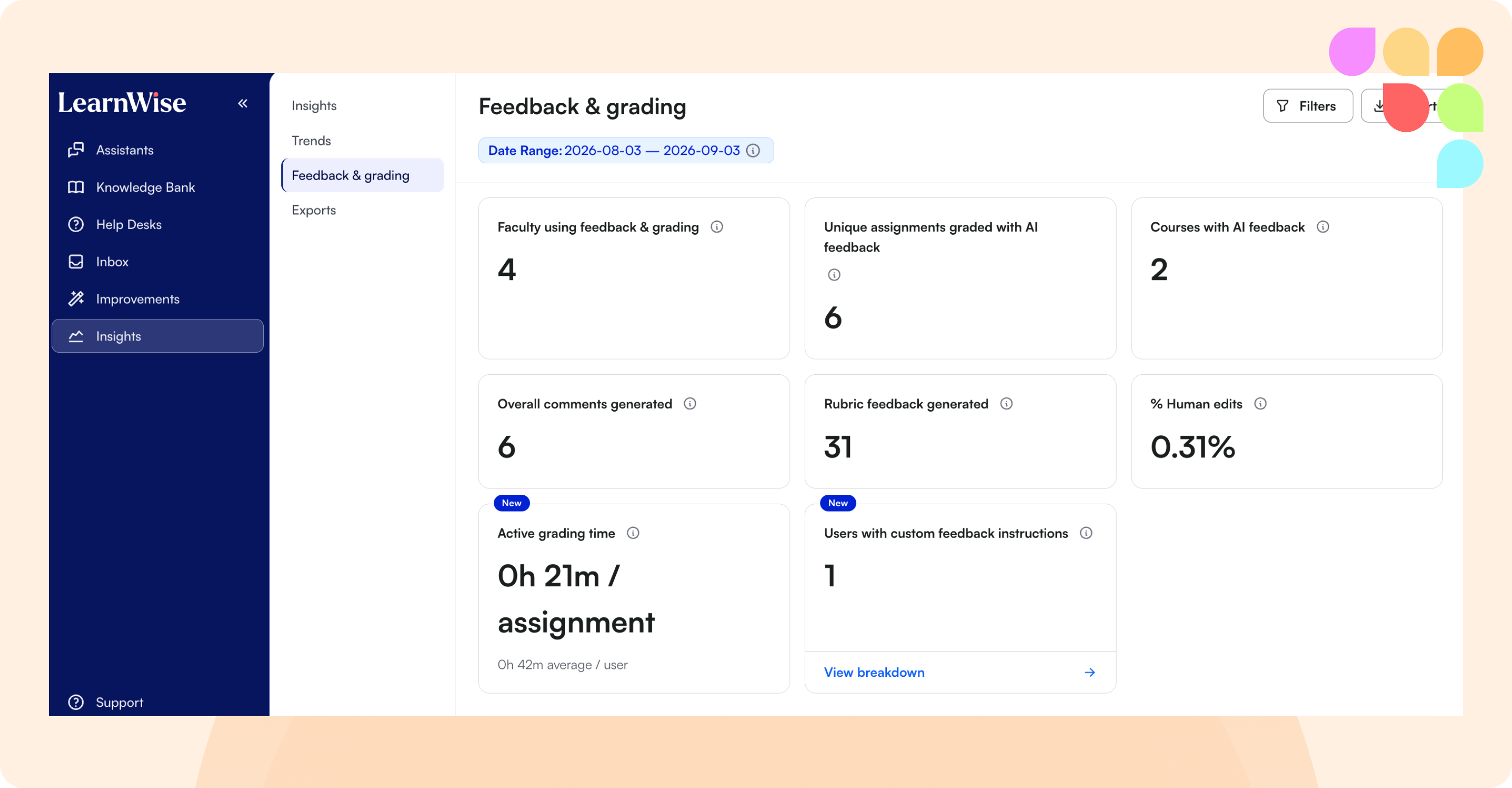
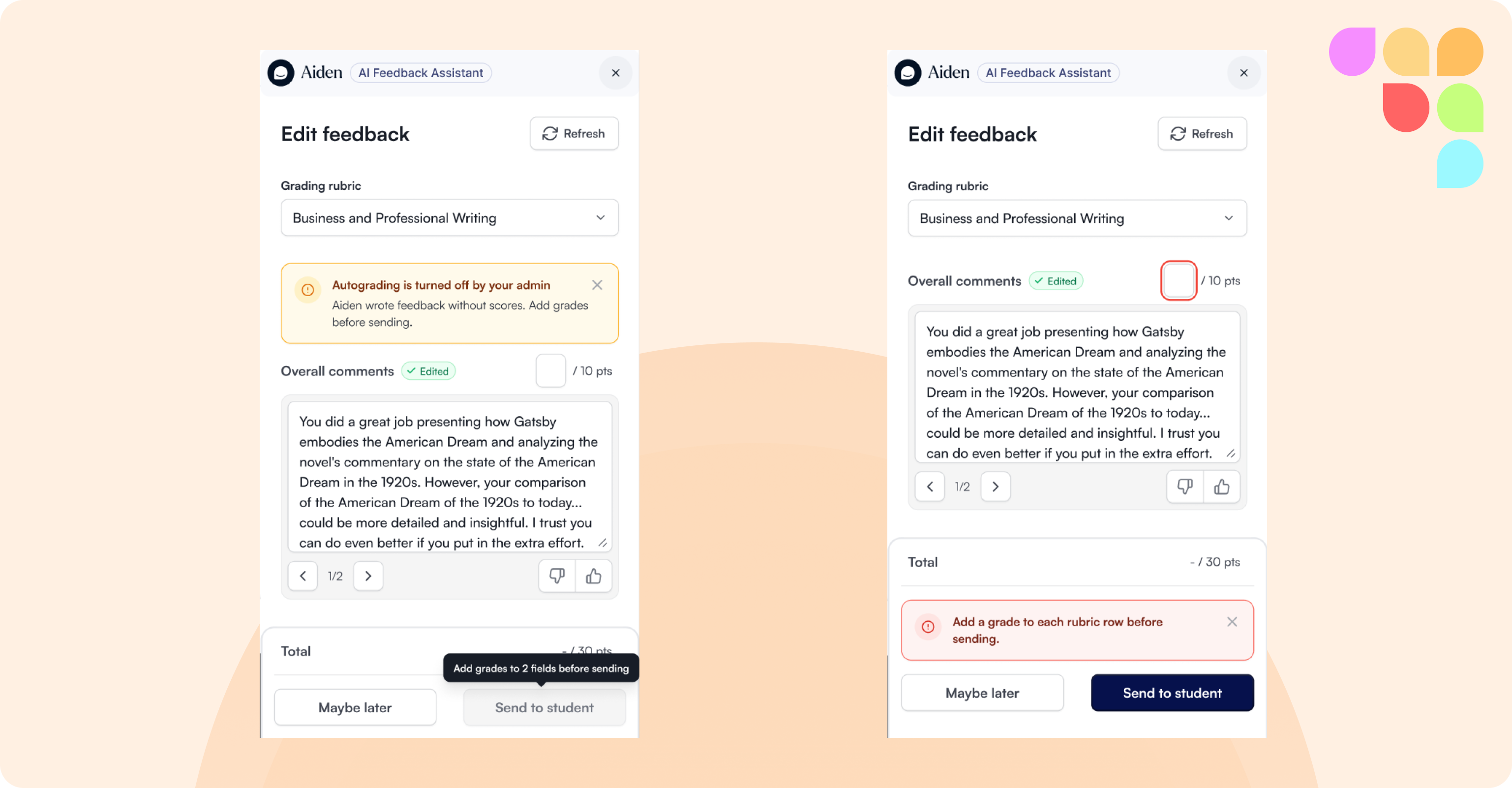
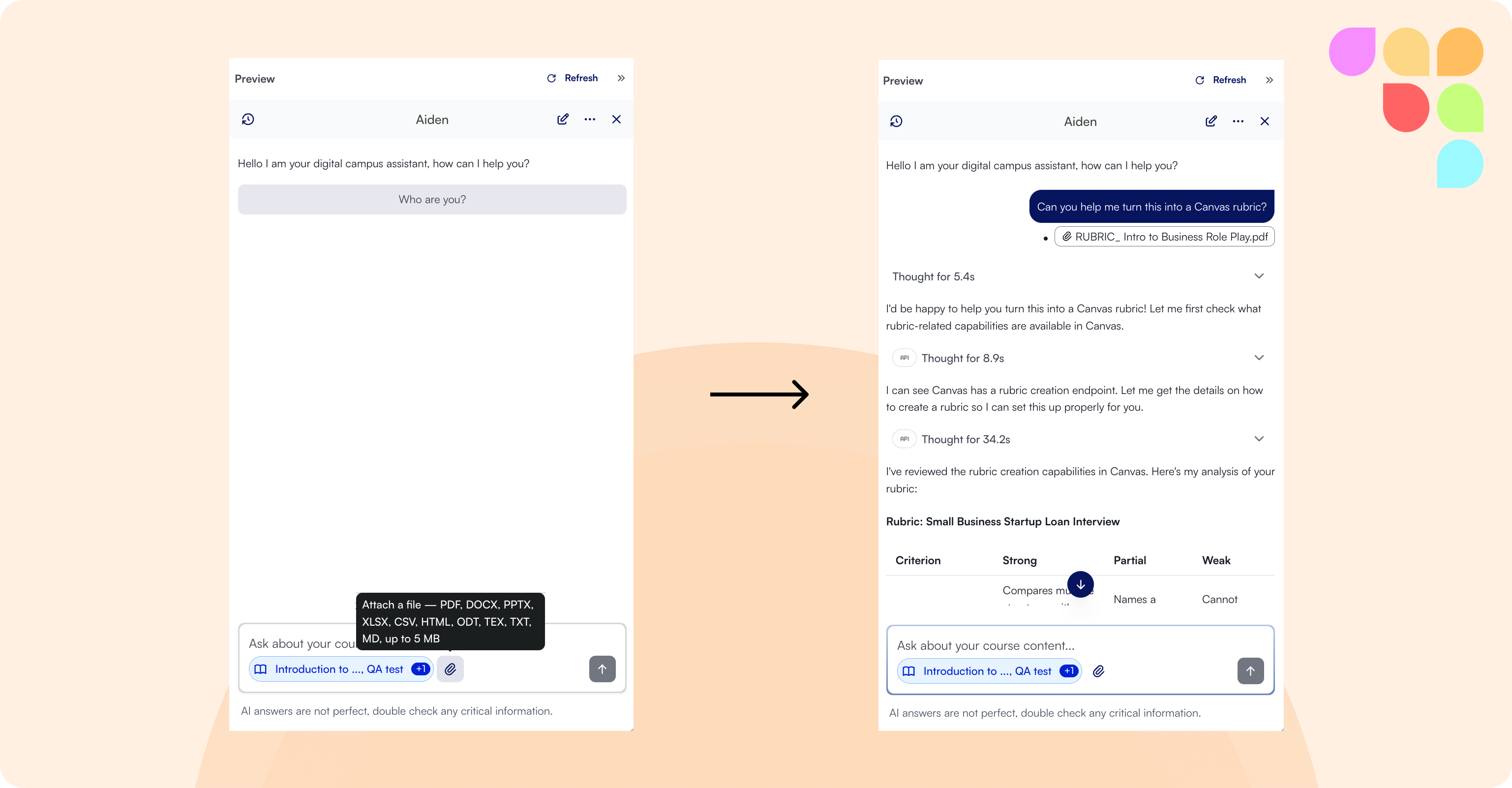
The feedback pipeline has been rebuilt from the ground up. The AI now analyses each part of a submission individually, producing more specific feedback and more accurate grading suggestions. Generation is faster on average, as the tool starts preparing in the background before the teacher opens it. Teachers set their personalization preferences once on first launch and they apply to all future sessions. Video and multi-file submissions are now supported.
π βWhat is AI Feedback & Grader?β
π βHow should instructors use AI Feedback & Grader?β
Note: The latest version of Feedback & Grader is rolling out gradually. Your Customer Success contact will confirm when it's available for your institution.

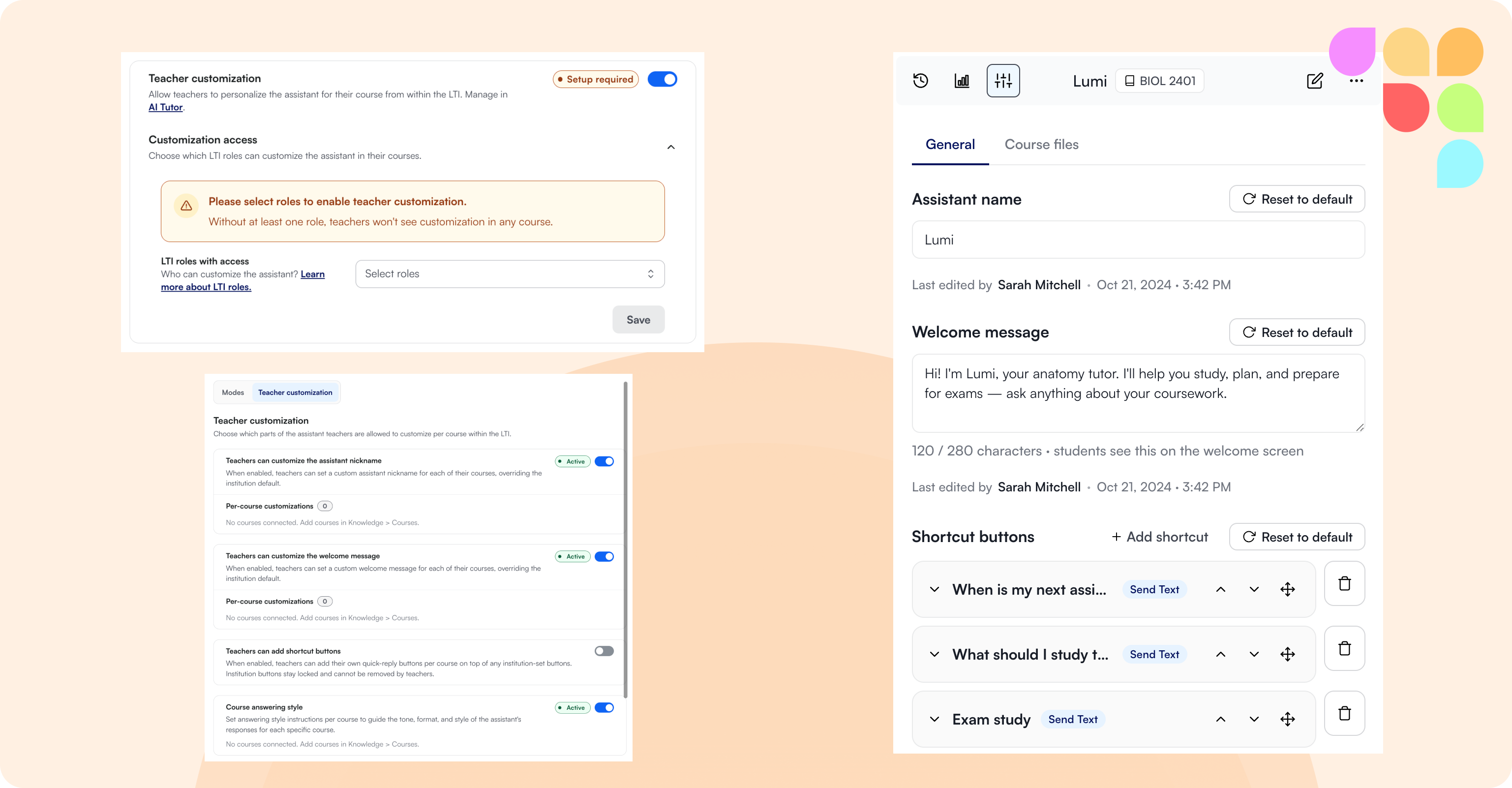
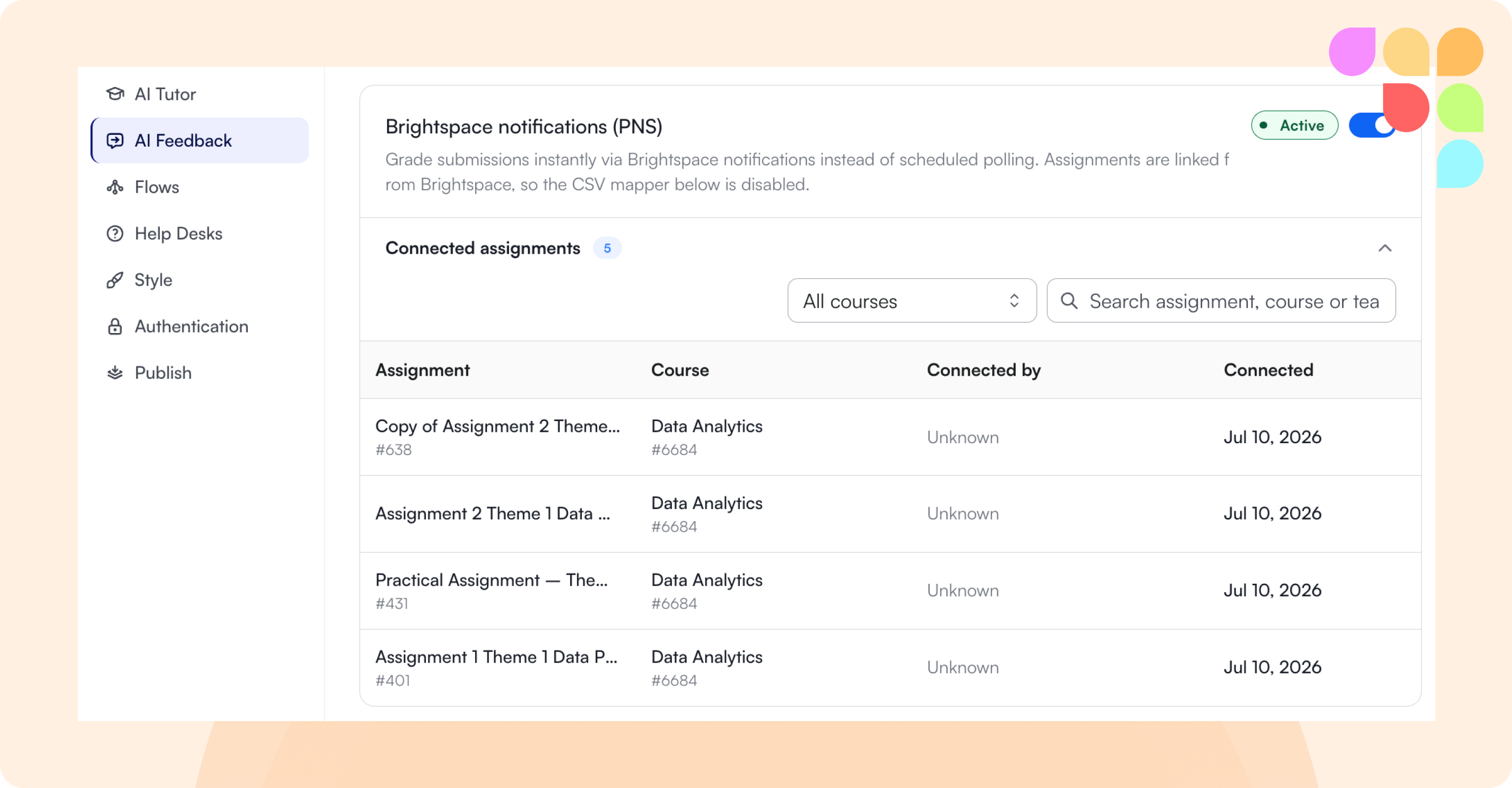
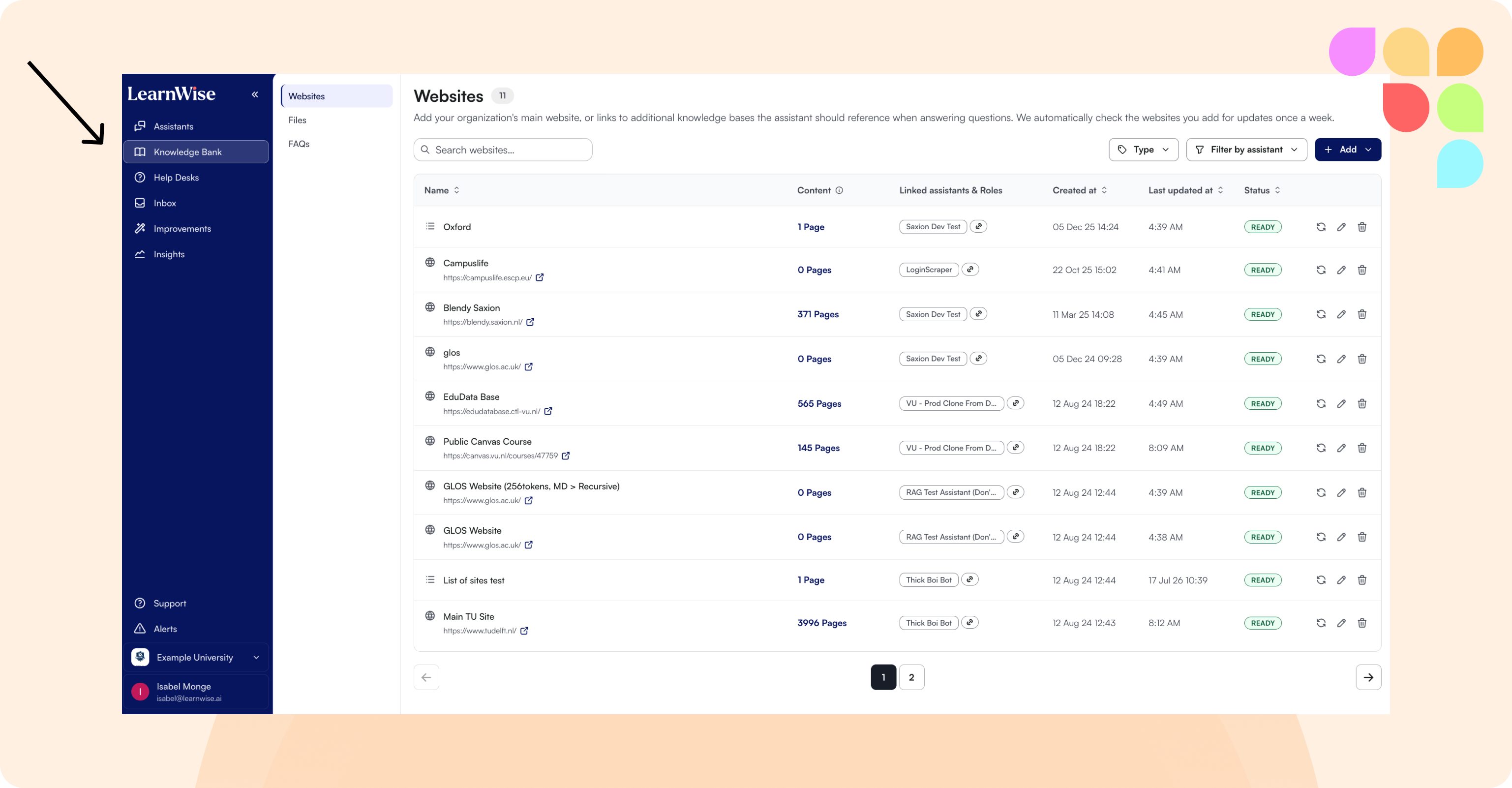
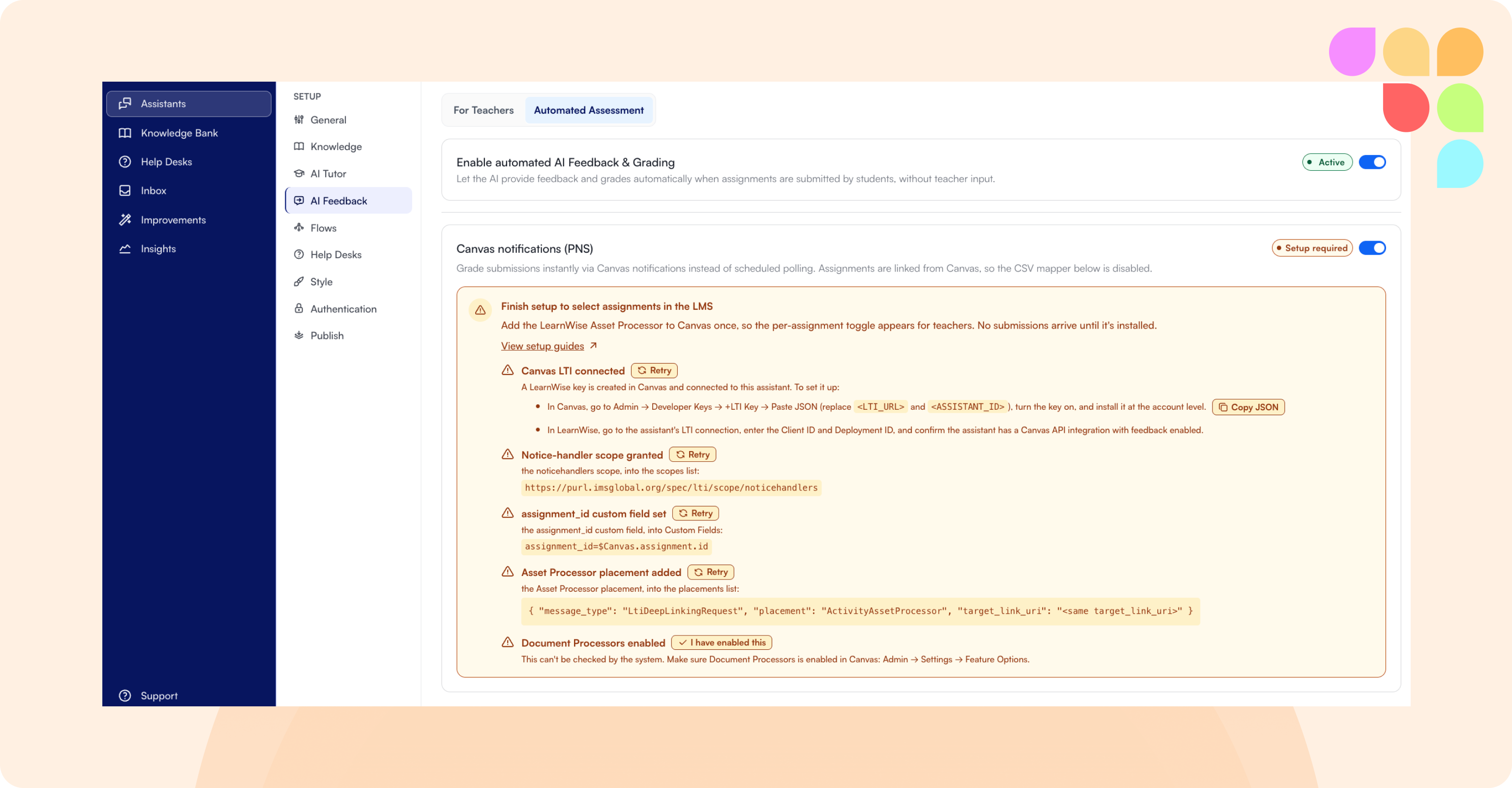
The LearnWise admin panel now has a new sidebar navigation and cleaner layout. Within each assistant, Study Mode and H5P settings have moved to a dedicated AI Tutor tab and AI Feedback now has its own tab, replacing the old Modes section. Cross-course settings now live under Knowledge, and the LearnWise help assistant is accessible from directly within the panel.

LMS credentials (Canvas, Moodle, etc.) can now be set up once at organization level and reused across multiple assistants, rather than configured separately for each one.
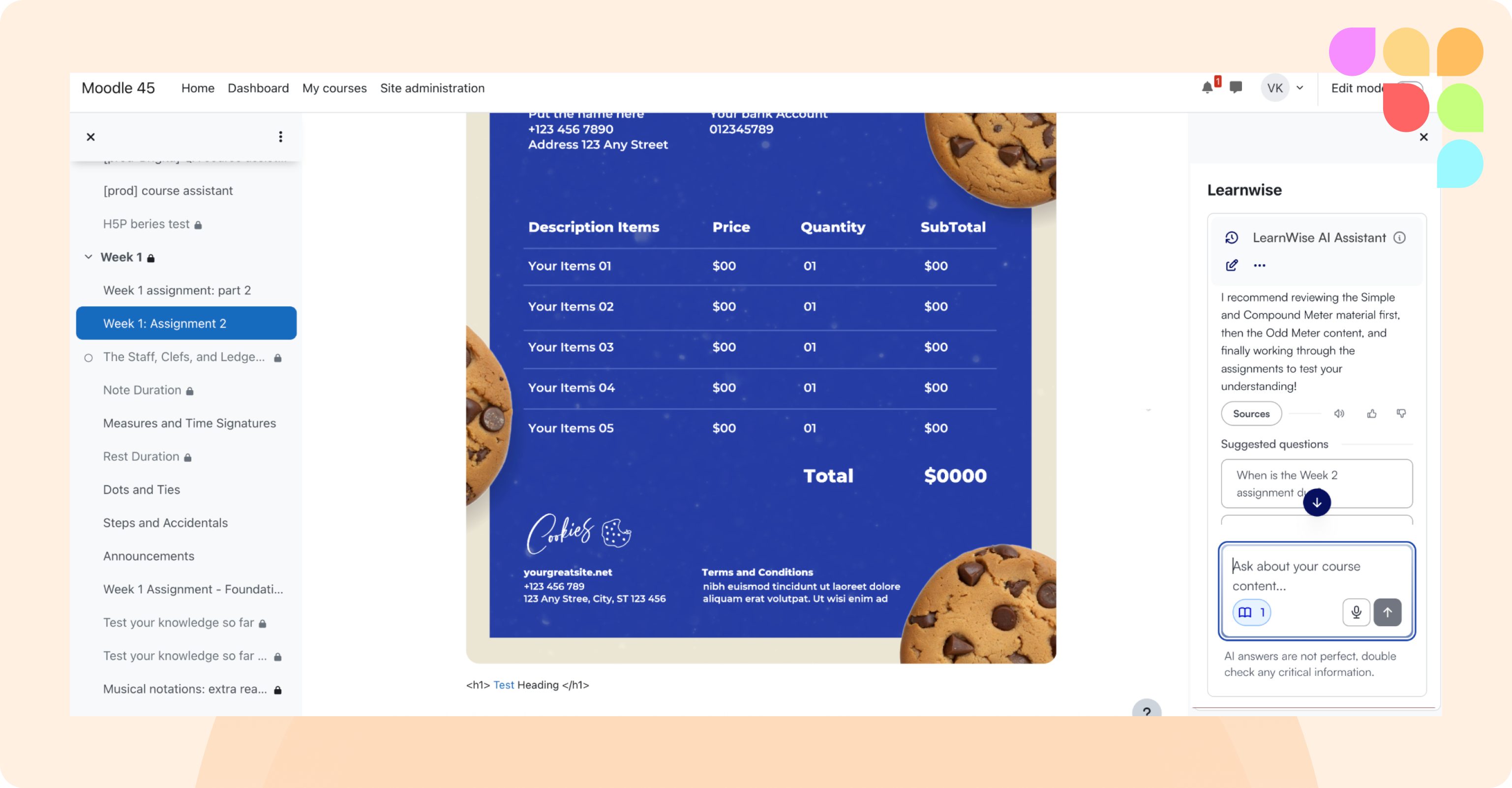
Students using LearnWise in MS Teams or Blackboard can now ask questions across all their enrolled courses in a single conversation. Course context is clearly shown when the assistant hands a conversation to a more specialized assistant.
Admins can now choose which specific team or queue a ticket goes to when setting up an escalation to Freshdesk, ServiceNow, or HubSpot.
Admins can now add or remove individual pages from an existing web knowledge source without deleting and re-configuring it. Fetch files sources now show which files have been found so admins can choose what to include.
French (France), German, and Japanese are now available as chat UI languages.
Admins can now be assigned permissions on a per-assistant basis, rather than only at the organization level. This lets institutions give specific staff access to manage individual assistants, for example different departments or teams managing their own assistants independently, without granting org-wide access.
π βWhat are the different roles that are available in the LearnWise dashboard?β

A new workflow action that automatically sends an email when a workflow is triggered, no API setup required. Admins configure the recipient, subject, and body, and can insert dynamic fields like the user's name, email, course name, and course ID. Useful for scenarios like student-at-risk alerts, where a counsellor or staff member needs to be notified when a student flags they're struggling.
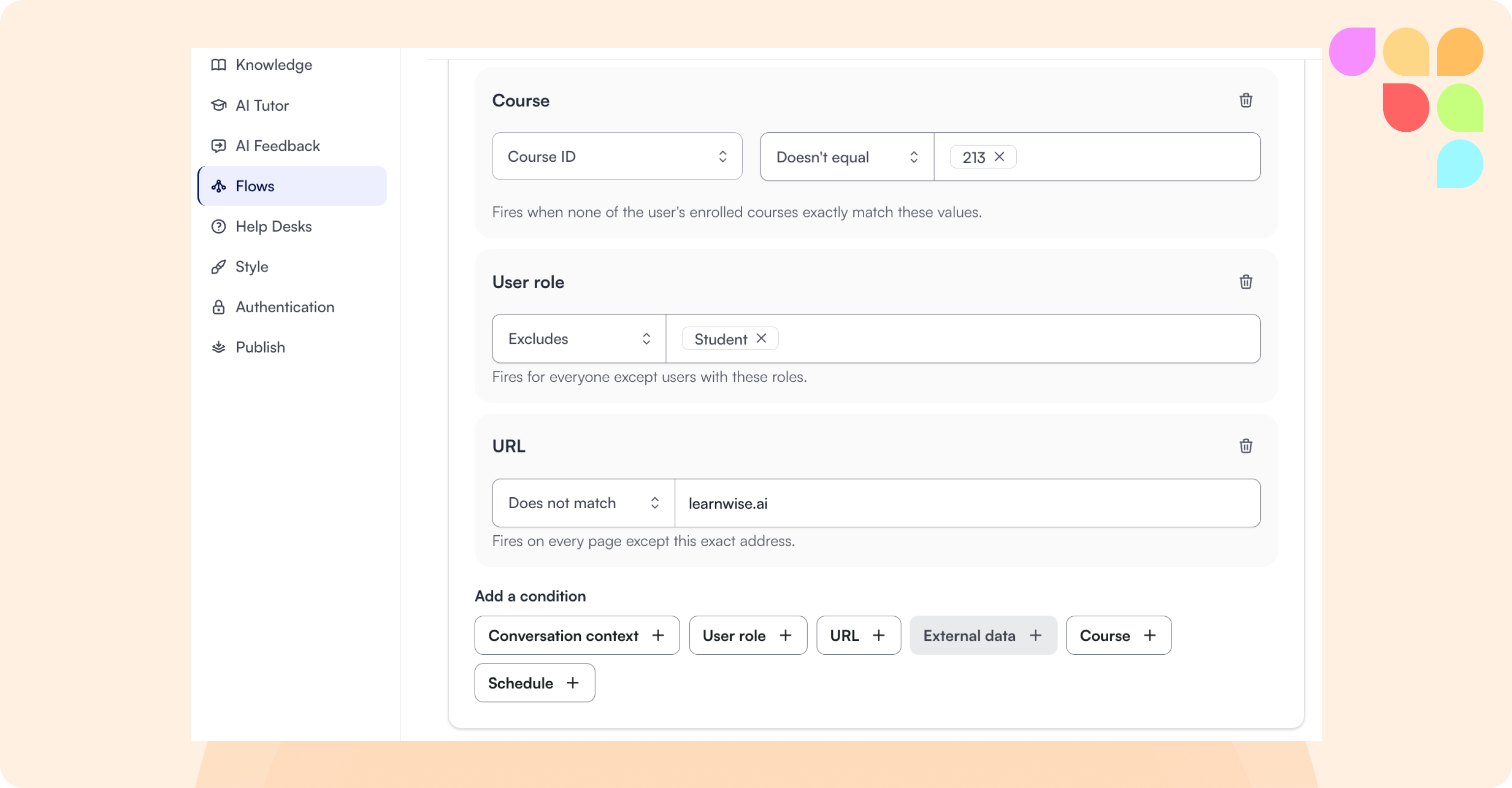
π βWhat are triggers and their corresponding responses in Flows?β

Admins can now set a custom font size for the assistant chat interface. The setting is available in the admin panel under Assistants > Style, and it applies to chat messages, suggested questions, and follow-ups.
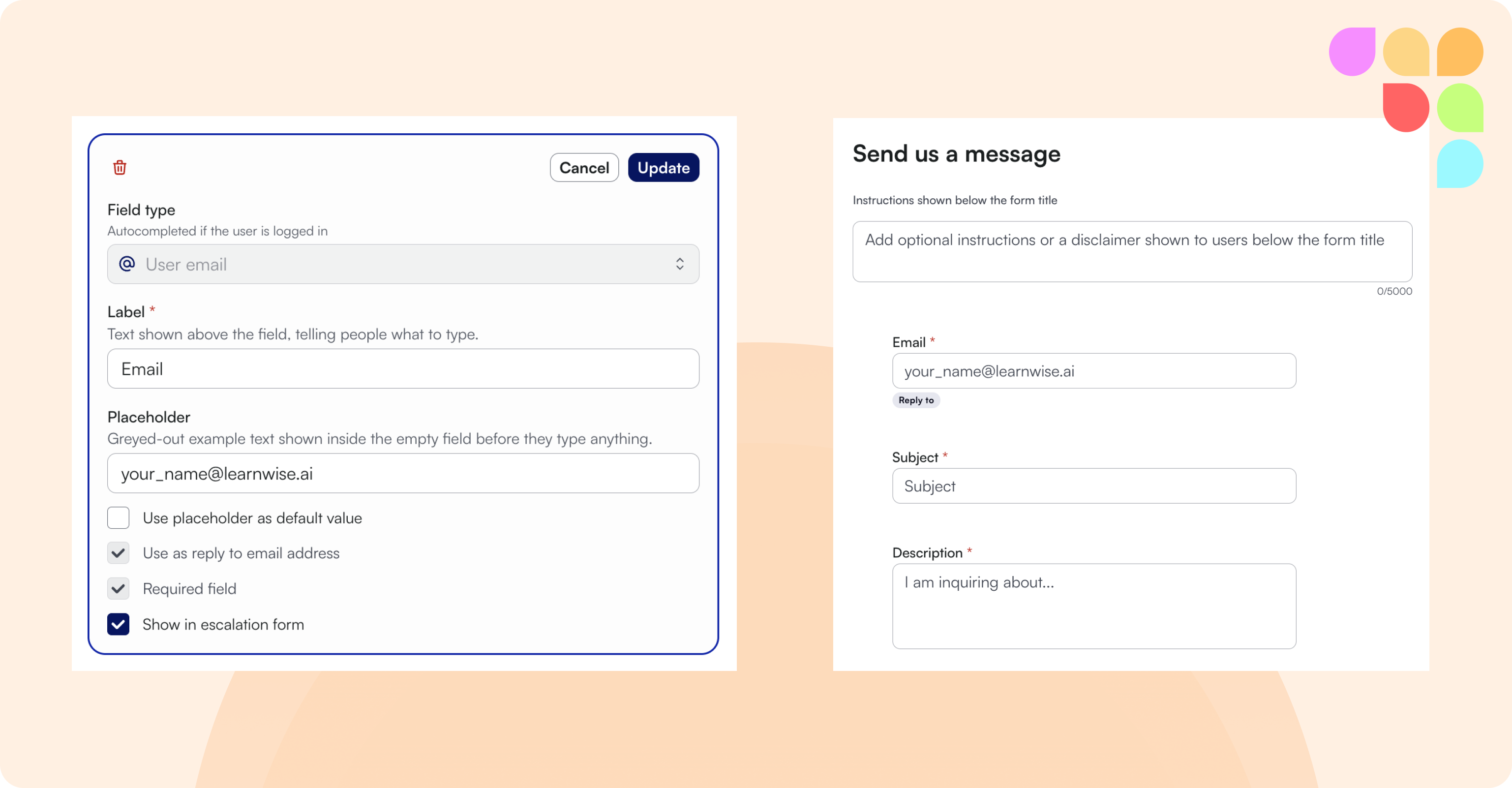
Admins can now manually reorder escalation methods and fields within help desks without having to delete and recreate them.
π βHow to connect my assistant to a help desk?β

The assistant can now connect to Microsoft Teams via API, giving students access to live course data including assignment deadlines, course content, announcements, and calendar events directly within their conversations.
Flow buttons now support two new action types. "Send Text Into Chat" inserts a prompt into the chat on click, and "FAQ" displays a saved FAQ answer directly in the conversation. This lets admins build flows that guide students with follow-up prompts and instant answers.

We have been working through a third-party accessibility audit to bring the end-user interface up to WCAG 2.2 AA compliance. This release includes a batch of fixes from that audit, improving the experience for students using assistive technologies.
Admins can now upload files (PDF, DOC, DOCX) directly to specific courses via a new Course Files tab in the assistant knowledge settings, without needing a full course scan. Files can be tagged to all courses or specific courses only.

Admins can now duplicate an existing assistant from the All Assistants screen. General settings, styles, flows, and FAQs are copied to the new assistant. Note that knowledge sources and help desks are not copied at this stage.

The improvements dashboard now supports filtering by LMS course ID. Filters are also applied when exporting, so the Course ID column will be reflected in exports.
Admins can now set a timezone when configuring Help Desk escalation availability. The end user will always see opening times converted to their own local timezone.

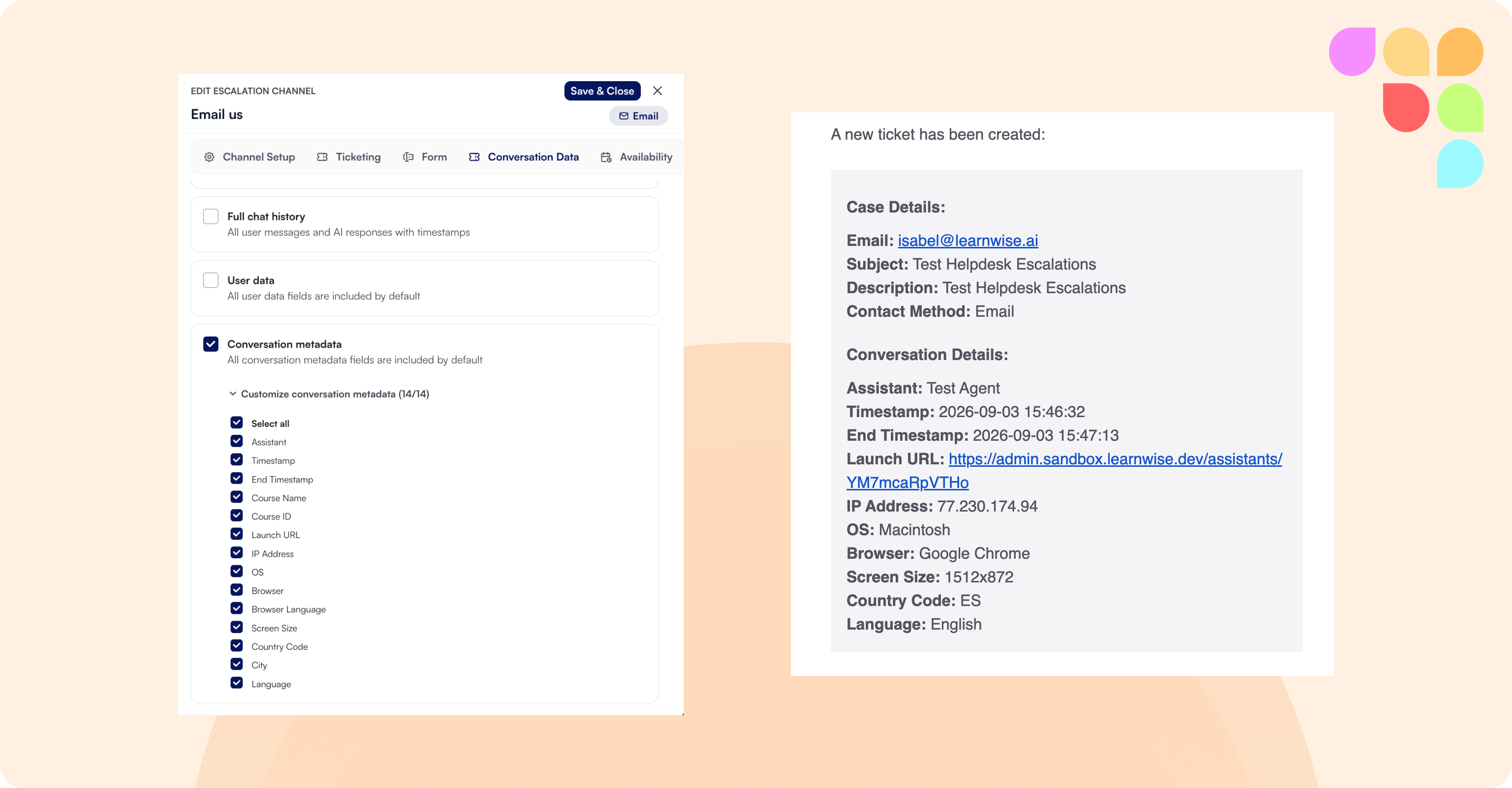
When escalating to a Help Desk, admins can now choose to push specific parts of the conversation into ticket fields, including a chat summary, full conversation history, and individual pieces of user metadata (e.g. name, email).

Reduced delay in response rendering so answers appear faster, particularly for longer responses.
Several improvements to the feedback generation pipeline, including sharper feedback quality with better rubric alignment and more reliable video submission handling.
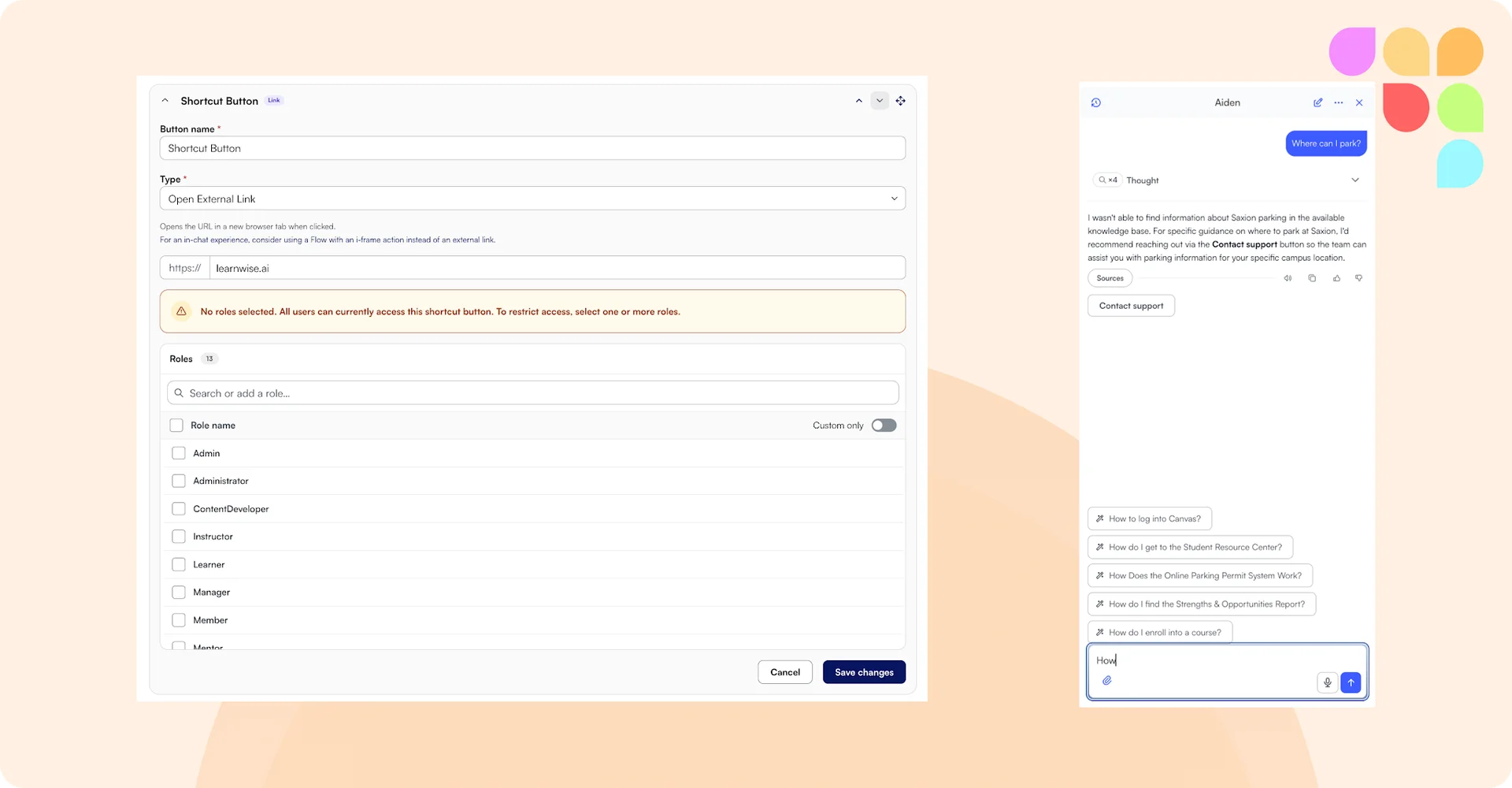
The limit on shortcut buttons has been increased to 50. When more than five buttons are configured, they are grouped under a "More" option in the chat interface to keep things clean.

Several accessibility fixes across the end-user front-end, including support for 200% zoom with correct text magnification and improvements for screen reader users.
Media files embedded in Moodle online text submissions are now processed and included in feedback generation.
The Teaching and Learning Assistant can now be configured to ignore student-generated posts across all MS Teams channels and announcements.
Restrict specific knowledge sources to certain user roles in websites, applications, and files. When users authenticate, they only see content relevant to their role. For example, restrict instructor-facing ServiceNow articles to faculty while keeping student support articles visible to everyone.

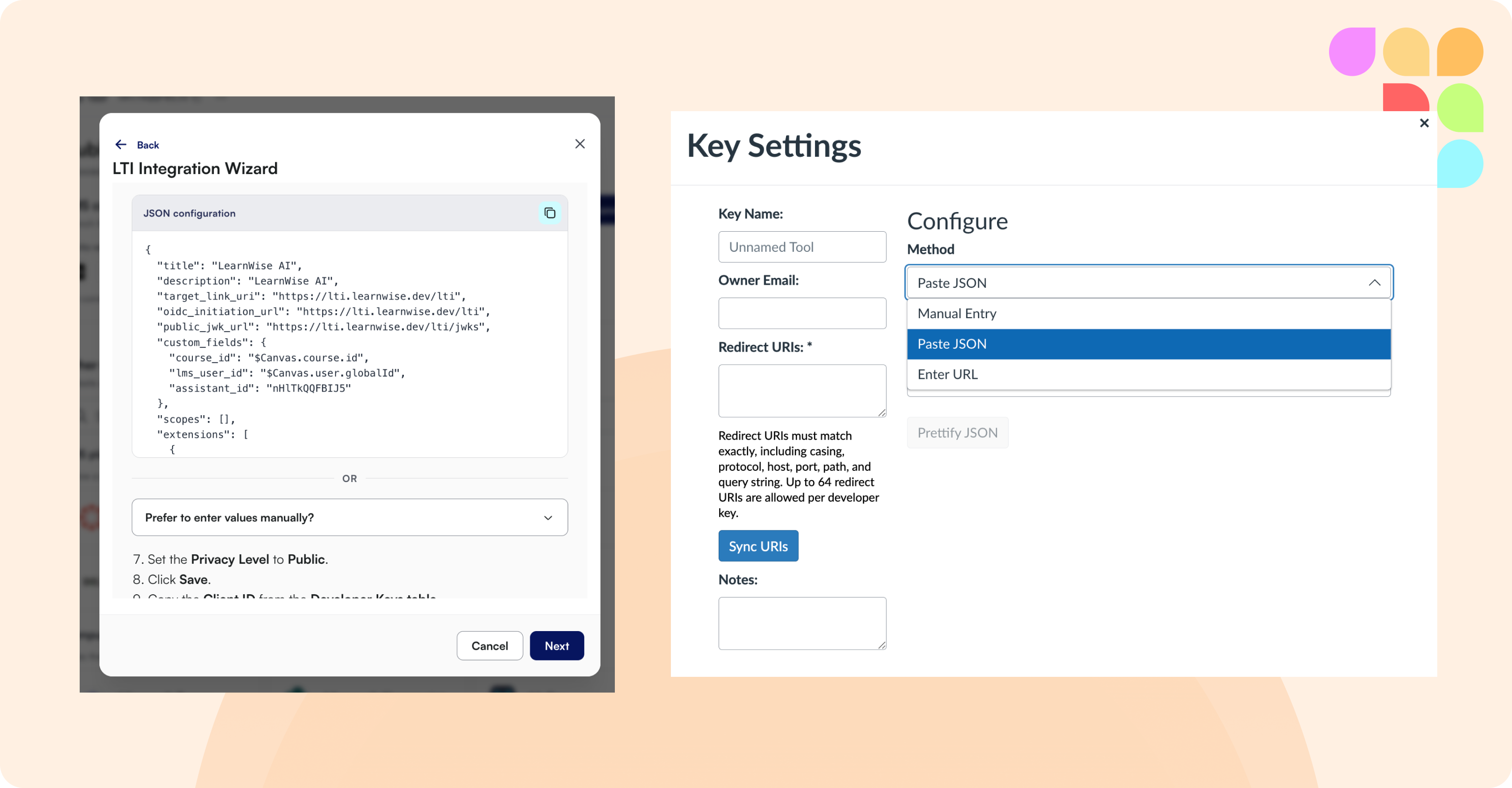
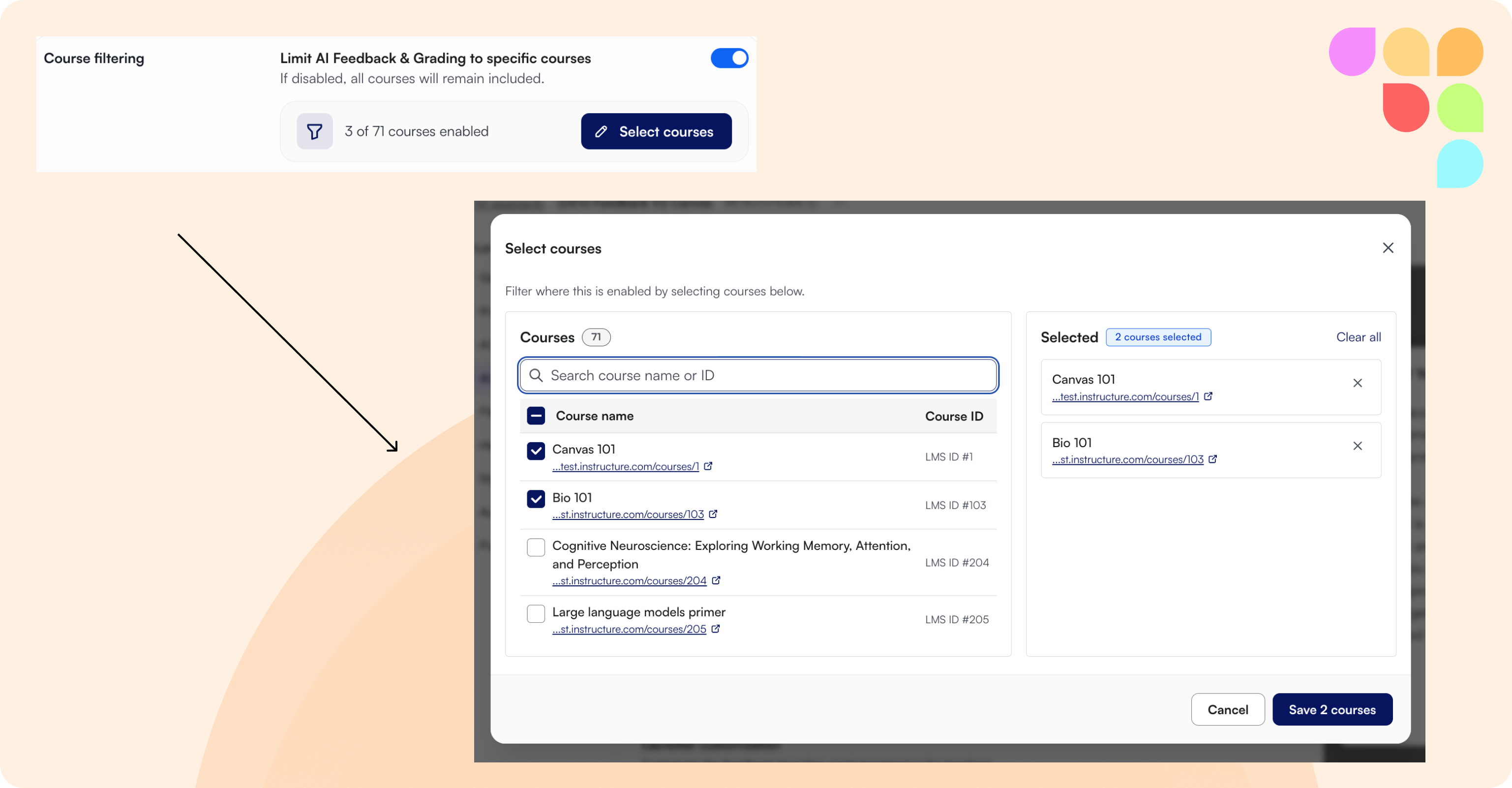
Control which courses can access your assistant through LTI by uploading a CSV of allowed or blocked course IDs. This enables controlled pilot rollouts to specific courses without managing individual LTI placements. Particularly useful for Blackboard UEF integrations where placement control is limited.

Improved AI-generated feedback for video submissions to accurately evaluate both content quality and presentation skills, ensuring meaningful assessment of video assignments.
Added Dutch, French, German, Irish, and Welsh language options for chat interface translation.
Escalation options now show when support is available. If currently closed, users see the next available day and time, helping them know when to expect help.

The feedback tool now supports .tex files for institutions with math-heavy or technical coursework.
Added toggle to enable or disable content-level access checking in Moodle, giving you control over whether the assistant respects module restrictions and availability conditions.
You can now resize the chat window horizontally by dragging the edge, giving you control over the width to fit your workflow needs.

Configure API POST requests directly within Help Desks and Flows to integrate with external systems (e.g., SIS, CRM, and automation tools). Supports multiple authentication methods (API Key, Bearer token, JWT Bearer, Basic Auth) and dynamic variables like user information and conversation data.

Feedback generation now offers more granular length control with four options: Short, Medium, Long, and Unrestricted, giving you better control over feedback detail.

Implemented dynamic model selection as a switchable feature to optimize performance and cost based on task complexity.
When only one rubric exists, it now automatically expands in the grading interface, reducing clicks and improving grading efficiency.
Mandatory fields (name, description, email) have been removed when escalating to a phone number or external URL, creating a faster support experience.
iFrame workflow actions now support custom height settings, allowing better control over embedded content display.

The feedback tool now gracefully handles unsupported file types (e.g. ODT) with clear messaging.
Filter states are now consistently cached across Inbox, Improvements, and Feedback Insights pages.
Conversations now start fresh after 1 hour of inactivity or when starting a new browser session, ensuring cleaner context and more accurate responses for each topic.
Organizations can now hide user metadata (name, email, LMS User ID, IP address) in Inbox and Teacher Insights for enhanced privacy. Contact your LearnWise representative to enable this feature.

Added country and city filters to Inbox, making conversation data more actionable for reporting and analysis.

Improved query performance for Inbox conversations, resulting in faster load times for both the Inbox page and teacher dashboard.
CSV exports now open correctly in Microsoft Excel without formatting issues for complex conversations containing tables or multi-line content.
Instructors using Brightspace can now work with assignments that have multiple rubrics attached. Each rubric displays as an expandable accordion showing scores per criterion, total points, and grade levels. You can select which rubric to use for grading, and the overall score updates accordingly. This supports institutions that use separate rubrics for content assessment, writing mechanics, accreditation tracking, or peer evaluation.
Added live API access to Blackboard for real-time data retrieval including assignment deadlines, course information, and instructor details. This enables the assistant to provide up-to-date information directly from Blackboard.

Chat interface now supports multiple languages (French, Spanish, Brazilian Portuguese) with automatic detection based on admin settings. All UI elements including buttons, labels, error messages, and system notifications are translated to match the selected language preference.
Upgraded model for faster processing and higher quality feedback output
Added a comprehensive audit step to ensure consistency between custom instructions and base prompts
Implemented fallback feedback mechanism for assignments without rubrics
Added secondary re-ranker fallback to improve generation reliability
Enabled autograding by default when numerical scoring is enabled
Fixed settings synchronization issues in production environments
Increased character limits to 1000 characters for questions and 20,000 characters for answers
Added descriptive error messages and import guidance for better user experience
Fixed validation to prevent partial imports when character limits are exceeded
Added 2-second delay for content loading to improve crawl reliability for slower-loading pages
Fixed inbox conversation exports for long conversations to prevent timeouts
Added proper ARIA roles and semantic HTML elements for screen reader compatibility
Improved color contrast ratios for better readability
Implemented automatic announcements when assistant responses finish rendering
Added proper heading hierarchy for navigation
Fixed external link warning page errors when clicking links from inbox
Resolved escalation flow issues with phone number and URL options
Corrected Blackboard discussion URLs to include proper content identifiers
Fixed Flow trigger example character limit validation
Improved H5P smart triggering to reduce unnecessary clarification questions
Fixed agentic search streaming to properly complete when finished
You can now upload and integrate Course Learning Outcomes from Brightspace into your AI Feedback pipeline. The system automatically maps outcomes to rubric criteria and provides outcome-aligned feedback to students, helping ensure assessments stay connected to course objectives.

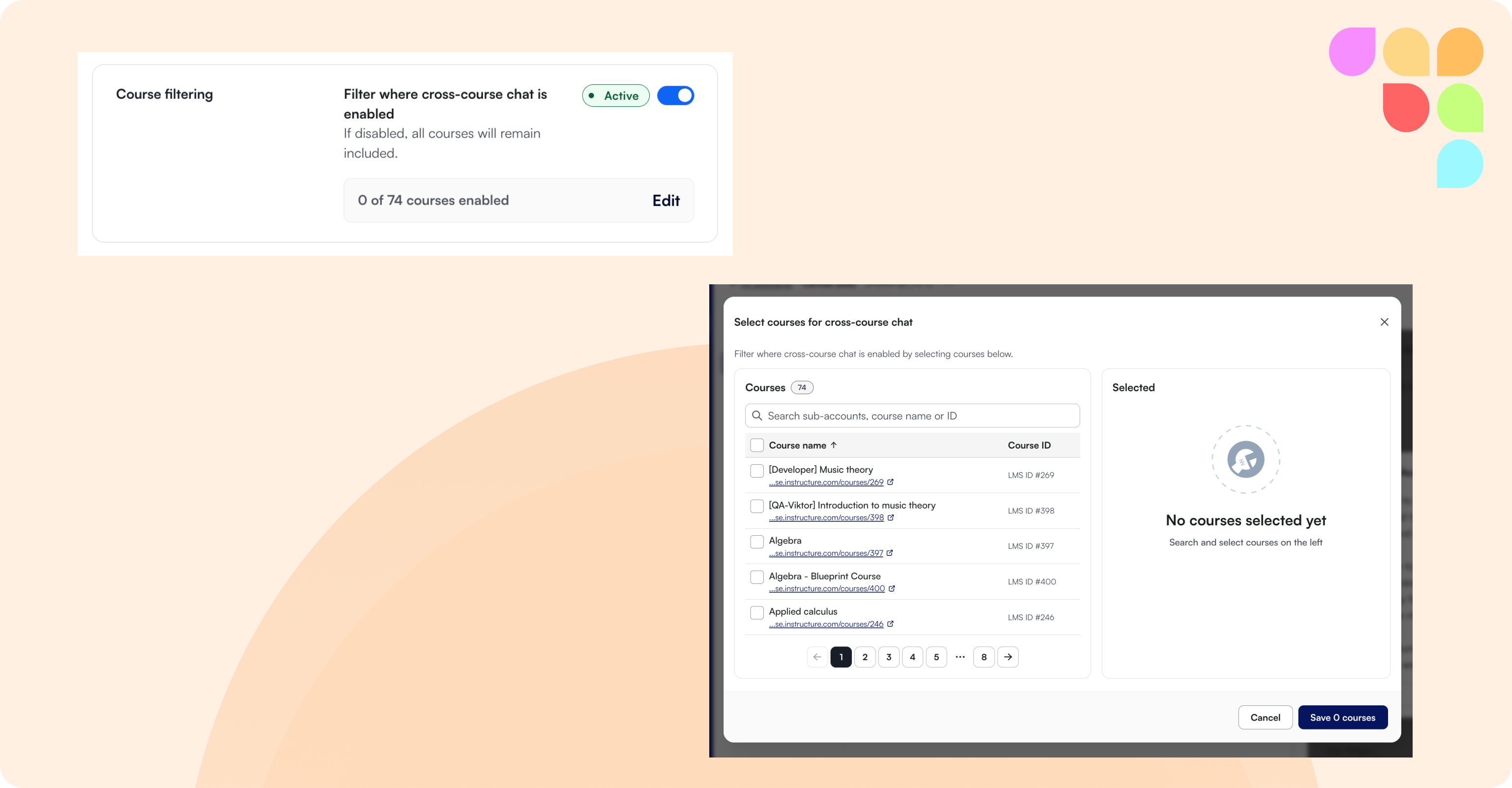
Admins can now manually add LMS courses by ID, allowing course content to be fetched in advance before students access the assistant. This eliminates the 2-15 minute wait when students first open the LTI or cross-course chat, ensuring tutoring content is ready immediately.

Implemented adaptive release content filtering for Moodle to ensure students only see content they have access to, respecting prerequisites, date restrictions, and completion requirements.
The system now provides meaningful feedback even when assignments lack configured rubrics, using a fallback mechanism to ensure students receive guidance regardless of assignment setup.
Error messages in the AI Feedback tool now clearly explain why an assignment isn't ready for grading, specifying issues like unsupported file types or missing rubrics instead of showing generic "not ready" messages.
The Modes interface has been redesigned with consolidated settings, clearer labeling, and consistent styling across all configuration sections for easier navigation and setup.
Escalation option creation and editing now happens in a right panel with auto-saving fields, improved availability customization, and clearer organization of helpdesk settings.
All insights tabs now support unified export functionality with proper filtering, naming, and file type selection. Exports are tracked in a dedicated Exports tab where you can monitor status and download completed reports.
Users can now change their course selection mid-conversation when using cross-course chat, providing more flexibility without needing to start a new conversation.
Overall feedback comments are now consistently weighted by the point value of each rubric item, ensuring that higher-value criteria have appropriate influence on the summary feedback.
The system now displays general location information (country and city) in the inbox, helping you better understand the geographic distribution of your students and provide more contextually relevant support.
Added support for dependent dropdown options in ServiceNow integrations, allowing category selections to dynamically determine available subcategories.